Petrol Subsidy App
Petrol Subsidy App Petrol prices in Pakistan have been rising steadily, and for millions of people, this is no longer just an economic issue but a daily survival challenge. From small shopkeepers to delivery riders and rickshaw drivers, everyone is feeling the pressure. A significant portion of monthly income is now spent on fuel, leaving very little for other household needs. In such conditions, the government’s move to introduce a targeted petrol subsidy through a mobile application is being seen as a serious attempt to provide relief where it is needed most.
From a ground-level perspective, general subsidies often fail because they benefit both rich and poor equally. This new Petrol Subsidy App is different. It is designed specifically for low-income citizens, ensuring that only deserving individuals receive support. This approach not only saves government resources but also improves fairness in distribution. If implemented properly, this could become one of the most impactful welfare initiatives in recent years.
Digital Fuel Relief System Near Launch
The Petrol Subsidy App has now entered its final stage of development, and according to official sources, it is undergoing rigorous testing before being launched nationwide. This stage is crucial because it ensures that the system works smoothly under real-world conditions. Authorities have tested the application with both users and petrol pump operators to identify and fix any possible issues.
This level of preparation shows a clear shift in how public welfare programs are being introduced. Instead of rushing the launch, the government is focusing on stability and reliability. The involvement of the Pakistan Digital Authority also indicates that modern technology and data systems are being used to build a transparent platform. For ordinary users, this means fewer technical issues and a smoother experience once the app becomes available.
Key Features and Subsidy Overview
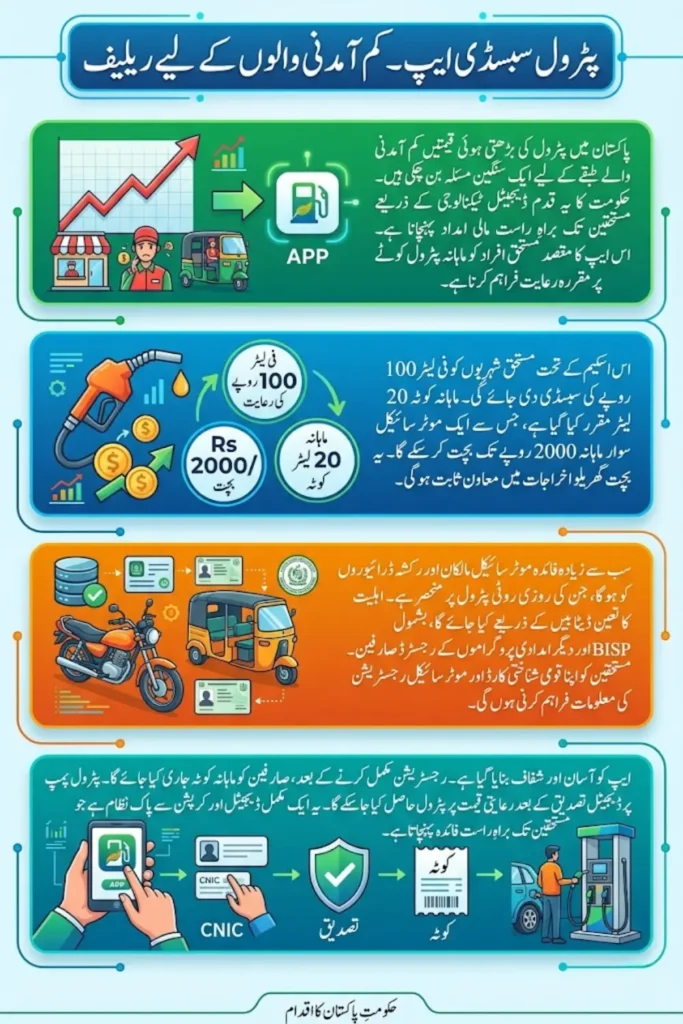
The Petrol Subsidy App is designed to provide targeted financial relief through a fixed petrol quota at discounted rates. Unlike previous schemes, this system is structured, limited, and data-driven, which increases its effectiveness and sustainability.
| Feature | Details |
|---|---|
| App Name | Petrol Subsidy App 2026 |
| Subsidy Amount | Rs. 100 per liter |
| Monthly Quota | 20 liters per user |
| Duration | 3 months (initial phase) |
| Target Group | Low-income individuals |
| Priority Users | Motorcycle & rickshaw owners |
| Verification Method | CNIC + Government databases |
This structure clearly shows that the government is aiming for controlled and meaningful relief rather than unlimited subsidies. By limiting the quota and duration, authorities can manage financial pressure while still helping those in need.
How the Petrol Subsidy App Will Work
The working mechanism of the Petrol Subsidy App has been kept simple so that even people with basic education and limited smartphone experience can use it without difficulty. The entire process is digital, which reduces the chances of corruption, delays, and manual errors.
The expected process includes:
- Users will download and install the Petrol Subsidy App on their mobile phones
- Registration will be completed using CNIC details
- The system will automatically verify eligibility through government records
- Approved users will receive a monthly petrol quota
- Petrol pumps will digitally verify users before providing subsidized fuel
This digital process eliminates long queues and unnecessary paperwork. It also ensures that users can access the system from their homes, saving both time and effort.
Eligibility Criteria and Who Can Apply
The success of this scheme depends heavily on proper targeting, and the government has clearly defined who can benefit from it. Only individuals who meet specific criteria will be eligible, which ensures that resources are not wasted.
Eligible individuals are likely to include:
- Families already registered under the Benazir Income Support Programme (BISP)
- Citizens who received assistance during COVID-19 relief programs
- Households affected by floods and listed in official records
- Individuals identified through poverty data systems
In addition to these conditions, applicants must own a motorcycle or rickshaw registered in their name. This requirement ensures that the subsidy is used for genuine transportation needs and not misused.
Focus on Motorcycles and Rickshaws
One of the most important aspects of this initiative is its focus on motorcycle owners and rickshaw drivers. These groups are among the most vulnerable when fuel prices increase because their daily earnings depend directly on petrol.
In many cities and towns, motorcycles are the primary mode of transport for working-class individuals. Similarly, rickshaw drivers rely on daily rides to earn their livelihood. When petrol prices rise, their income does not increase at the same rate, which creates financial stress.
This subsidy aims to support them by:
- Reducing their daily fuel expenses
- Helping maintain stable earnings
- Lowering transportation costs for passengers
- Providing financial breathing space to small earners
This targeted approach ensures that the subsidy reaches those who are most affected by rising fuel prices.
Subsidy Benefits and Financial Impact
The financial benefit of this scheme may appear limited at first glance, but for low-income households, it can make a noticeable difference. A subsidy of Rs. 100 per liter on 20 liters per month translates into significant savings.
For example, a motorcycle user who receives the full quota can save around Rs. 2,000 per month. Over a period of three months, this becomes Rs. 6,000, which is a meaningful amount for someone earning a modest income.
This relief can help families:
- Manage monthly budgets more effectively
- Spend more on essential items like food and education
- Reduce financial stress caused by fuel expenses
From a practical point of view, even small savings can have a big impact when combined with other household expenses.
Transparent System Through Data Integration
The government has placed strong emphasis on transparency by integrating multiple data sources into the system. This ensures that only verified and deserving individuals receive the subsidy.
The app uses data from:
- Benazir Income Support Programme (BISP)
- COVID-19 relief databases
- Flood relief beneficiary lists
By combining these records, the system can accurately identify low-income households. This reduces the chances of fraud and ensures fair distribution of resources. It also builds trust among citizens, as they can see that the process is based on verified data rather than personal influence.
Testing Phase and System Reliability
Before launching the app, authorities have conducted extensive testing to ensure reliability and performance. This step is essential to avoid technical problems once the system is open to the public.
Testing activities included:
- Checking user registration and login systems
- Verifying fuel transaction processes at petrol pumps
- Testing quota allocation and verification mechanisms
- Conducting load testing to handle thousands of users simultaneously
- Ensuring data security and privacy protection
Such thorough testing indicates that the government is serious about delivering a smooth and efficient service. It also reduces the risk of system failures during peak usage.
Implementation Support and Government Coordination
The success of the Petrol Subsidy App depends not only on technology but also on coordination between different departments. Petrol pumps, provincial governments, and registration authorities all have important roles to play.
Key responsibilities include:
- Petrol pumps verifying users through the digital system
- Provincial governments supporting local implementation
- Authorities facilitating vehicle registration processes
- Ensuring smooth communication between departments
This coordinated effort is necessary to ensure that the subsidy reaches users without delays or complications.
Future Outlook and Expected Rollout
With the testing phase nearing completion, the Petrol Subsidy App is expected to be launched soon. Once launched, the registration process will begin, followed by eligibility verification and subsidy distribution.
In the coming weeks, users can expect:
- Official announcement of the launch date
- Opening of app registration for the public
- Start of eligibility checks
- Distribution of subsidized petrol
If the system performs well, there is also a possibility that the program could be extended or expanded in the future.
Final Words
The Petrol Subsidy App represents a modern and targeted approach to economic relief in Pakistan. Instead of broad subsidies that benefit everyone, this system focuses on those who genuinely need support. By using digital technology and verified data, the government is trying to create a fair and transparent system.
From what can be observed, this initiative has the potential to reduce financial pressure on low-income households, especially those who depend on petrol for their daily livelihood. While it may not solve all economic problems, it is certainly a step in the right direction.